
Enterprise Architecture
APIBASE replaces monolithic database systems with a network of deterministic, department-owned data domains.
Department Isolation
Each department owns its BASE file. No shared schema, no global locking, no cross-system failure propagation.
Controlled Data Routing
All cross-domain access is routed through Hive with strict ACL validation. No direct database exposure.
Git-Native Storage
BASE files are deterministic and versionable. Data becomes traceable, diffable, and rollback-safe.
1. Department-Based Storage Model
Traditional architectures rely on a single shared database. This creates coupling, contention, and systemic risk.
APIBASE eliminates this by assigning each department full ownership of its physical storage:
/data/users/finance/finance.php
/data/users/inventory/inventory.php
/data/users/hr/hr.php
2. Hive Gateway & Scoped Access
Hive acts as the enterprise execution layer. It routes requests between domains without exposing storage.
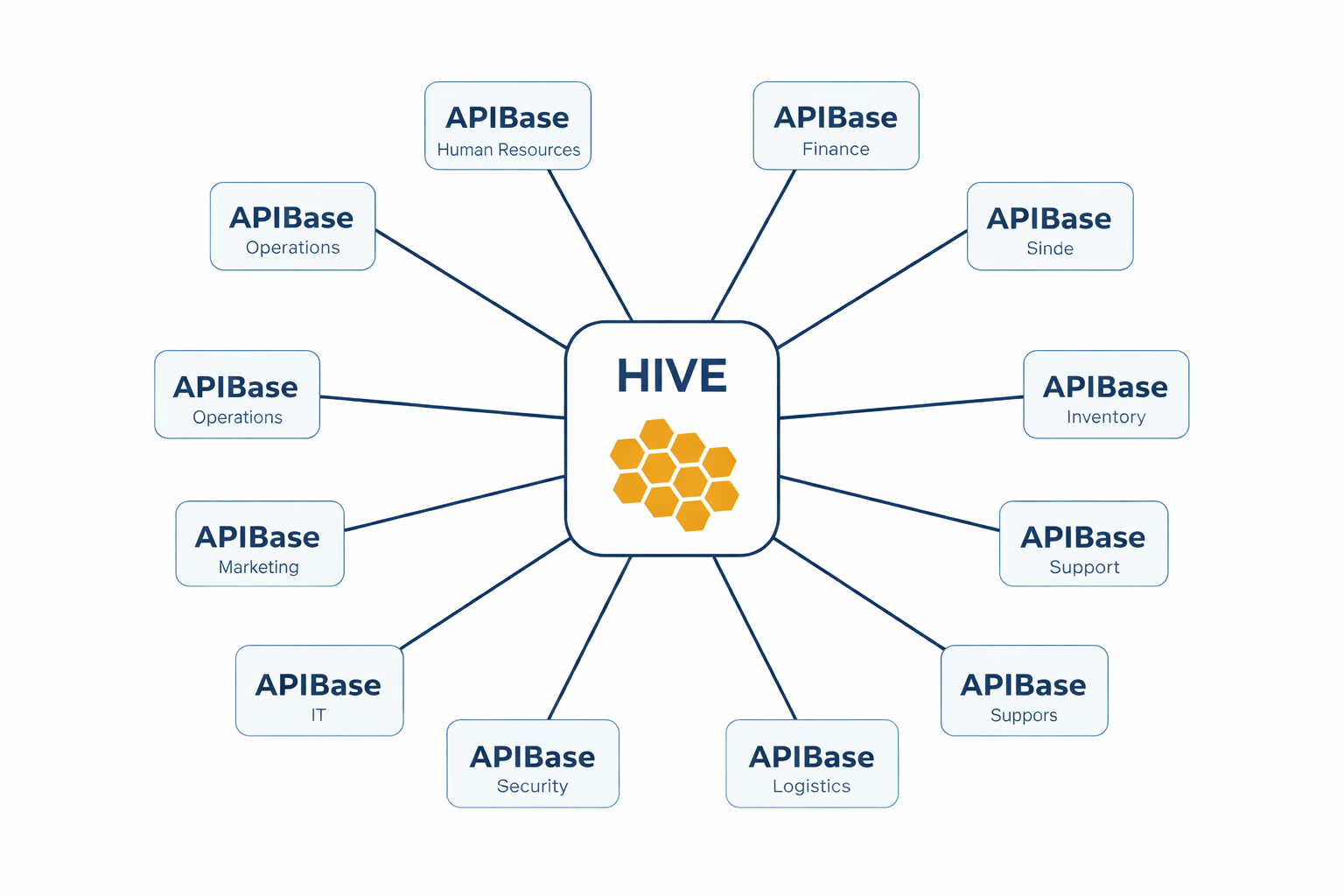
- Ownership: Each department operates as an independent data domain.
- Access: Tokens define scope (
fullorhive). - Validation: ACL rules are enforced before execution, not after.
3. Execution Pipeline
Every request follows a strict, deterministic validation path:
1. Token Validation
2. Context Resolution (User or Hive)
3. ACL Enforcement
4. BASE Routing
5. TLC Execution
4. Operational Resilience
| Traditional Architecture | APIBASE Enterprise |
|---|---|
| Shared database engine | Isolated BASE domains |
| Global schema dependencies | Independent data ownership |
| Cascading failures | Contained impact |
| Opaque binary storage | Readable, versioned data |
| Heavy infrastructure | Lightweight execution model |
5. Strategic Advantage
APIBASE is not an incremental improvement. It changes the data model:
- From shared systems → to owned domains
- From query-based access → to coordinate-based execution
- From opaque storage → to transparent, versionable data