
 The TLC Data Model
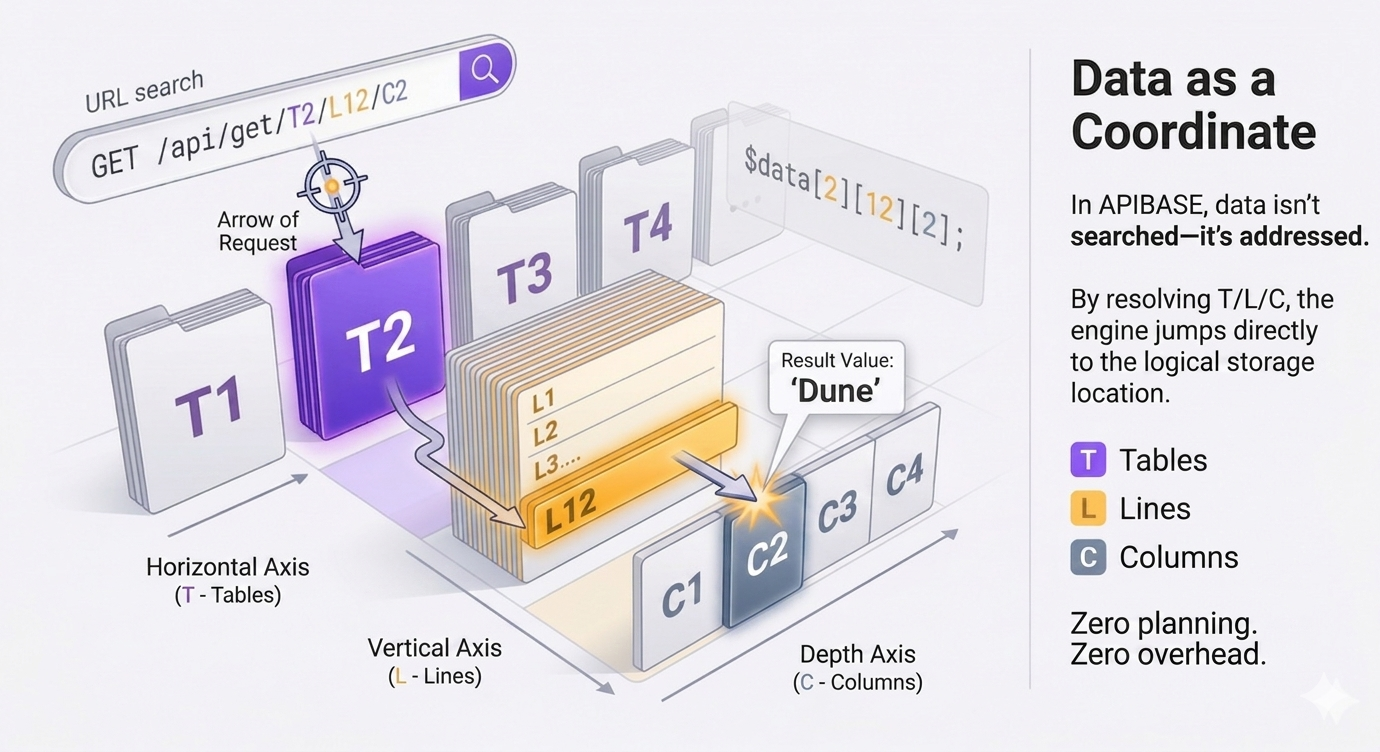
APIBASE organizes data using a deterministic physical model called TLC — Table · Line · Column.
In this model, every piece of information has a fixed, predictable coordinate within a BASE file. This structure allows the engine to navigate directly to the data without the need for a complex query planner.
$data[table][line][column]
1. The Table Registry (Table 0)
Every BASE contains a reserved table at index 0. This is the registry that maps table IDs to their logical names.
$data[0][0][1] = 'authors';
$data[0][0][2] = 'books';
$data[0][0][3] = 'publishers';
Note: Table 0, Line 0 is the starting point for all discovery within the BASE.
2. Table Schemas (Line 0)
Within any given table, Line 0 is reserved for the schema (column headers). This makes the BASE file self-descriptive.
// Structure for Table 2 (books)
$data[2][0][1] = 'id_book';
$data[2][0][2] = 'title';
$data[2][0][3] = 'author_id';
3. Data Records (Line 1+)
Actual data records begin at Line 1. Each line represents a physical slot in the storage array.
$data[2][1][1] = '1';
$data[2][1][2] = 'Dune';
$data[2][1][3] = '1';

$data[2][2][1] = '2';
$data[2][2][2] = 'Foundation';
$data[2][2][3] = '2';
4. Deterministic Relations
Relations in APIBASE are explicit. One cell simply contains the value of another record's primary identifier.
// Author in Table 1, Line 1
$data[1][1][1] = '1';
$data[1][1][2] = 'Frank Herbert';

// Book in Table 2, Line 1 referencing Author ID '1'
$data[2][1][3] = '1';